Vietnam Announces 9 Pillars of National AI Transformation Strategy: Where Are Small Businesses in This Picture?
Vietnam Announces 9 Strategic Pillars for National AI Transformation: Where Do Small Businesses Stand in This Picture?
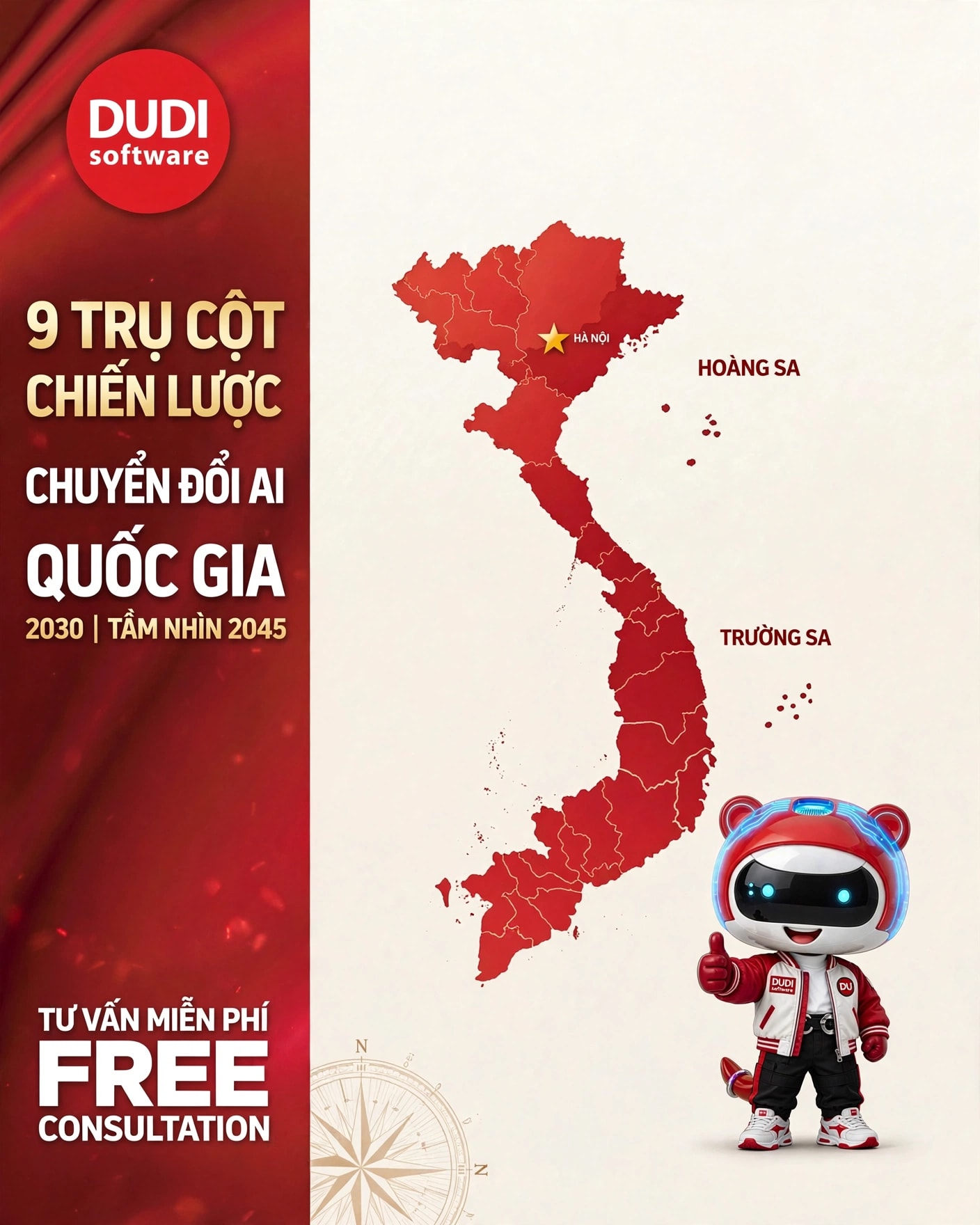
Vietnam is finalizing the draft "National AI Transformation Strategy" for 2030, with a vision to 2045 — a document designed to elevate artificial intelligence from a "support tool" to a "core competency" in governance, research, innovation, and economic activities nationwide.
The difference lies in one word: "conversion" instead of "application".
According to Dr. Tran Anh Tu, Deputy Director of the Information Technology Industry Department (Ministry of Science and Technology), what is noteworthy in this strategy is the deliberate use of words: instead of saying "AI application," it says "AI transformation." This difference is not just in terminology. AI transformation is defined as a comprehensive restructuring of the operations of organizations, industries, and nations based on AI — aiming to create new capabilities in management, production, and innovation, rather than simply "adding" an AI tool to existing workflows.
In other words, the goal isn't whether a business uses ChatGPT or some other AI tool, but whether AI is actually integrated into how the problem is defined, designed, and operated from the outset.
Nine strategic pillars, and one pillar specifically for small businesses.
The draft strategy identifies nine pillars: AI human resources and skills for the entire population; AI data and models; AI infrastructure; research, development, and mastery of AI technology; AI in national governance; AI for industries and sectors; AI for small and medium-sized enterprises, household businesses, and cooperatives ; AI ecosystem; and safe and reliable AI governance.
The existence of a dedicated pillar for small and medium-sized enterprises (SMEs), household businesses, and cooperatives shows that this group is not being overlooked in the national strategy — contrary to the common concern that major technology policies often only serve corporations. This is also the next piece in a series of recently announced policies: from Decree 20/2026 supporting free digital platforms for household businesses, the AI training program for 18,700 small businesses in Thai Nguyen, to the plan to digitally transform 200,000 SMEs in Ho Chi Minh City.
Specific targets: 500,000 AI professionals, 10 million workers with general skills.
The strategy aims to train at least 500,000 highly skilled AI professionals by 2030, while also popularizing basic AI skills for at least 10 million workers. Notably, the strategy doesn't just address the development and application of AI in a general way, but focuses on measuring the specific impact of the technology on productivity, costs, revenue, management quality, and competitiveness—as a basis for evaluating whether the AI transformation truly creates change or remains merely a slogan.
Practical implications for small and medium-sized enterprises
For business owners without deep technological expertise, here are some key takeaways:
First, the policy trend is very clear and consistent — AI is no longer a "desirable" option but is being positioned as national infrastructure, similar to electricity or the internet. The slower businesses adapt, the greater the gap with their competitors will become over time.
Secondly, having a separate pillar for SMEs and household businesses means there will be more specific support policies in the future — training resources, platforms, and possibly even financial support. Businesses that proactively monitor and access these policies early will have an advantage over those who wait.
Third, and most importantly: "AI transformation" requires more than simply purchasing an AI tool. It requires businesses to have a sufficiently robust digital foundation—websites, data management systems, digitized operational processes—for AI to truly demonstrate its value, rather than being just a disconnected utility.
What businesses should do right now
- Assess your current digital platform —website, management system, customer data—to see if it's digitized and has a clear structure for AI to utilize.
- Keep an eye out for AI support programs for SMEs once the official strategy is released — these often include free training and support platforms.
- Prioritize building a solid digital foundation before deep AI integration — a good data management system will make AI far more effective than using AI on a fragmented, manual platform.
- Training the workforce in basic AI skills — anticipating the trend of AI adoption for the labor force, which is the national strategy in place.
Conclude
The National AI Transformation Strategy is the clearest signal yet regarding Vietnam's long-term direction: AI is no longer a technology for "experimentation," but is becoming a core competency of the entire economy. For small and medium-sized enterprises, the question should not be "should we transform into AI?", but rather "where to start, and what foundations need to be in place first."
Dudi Software partners with businesses to build a solid digital platform — websites, data management systems — as a foundation to prepare them for the AI transformation journey ahead.
If you'd like to assess your business's current digital platform, contact Dudi Software for personalized advice.
📞 Message Dudi Software to discuss.