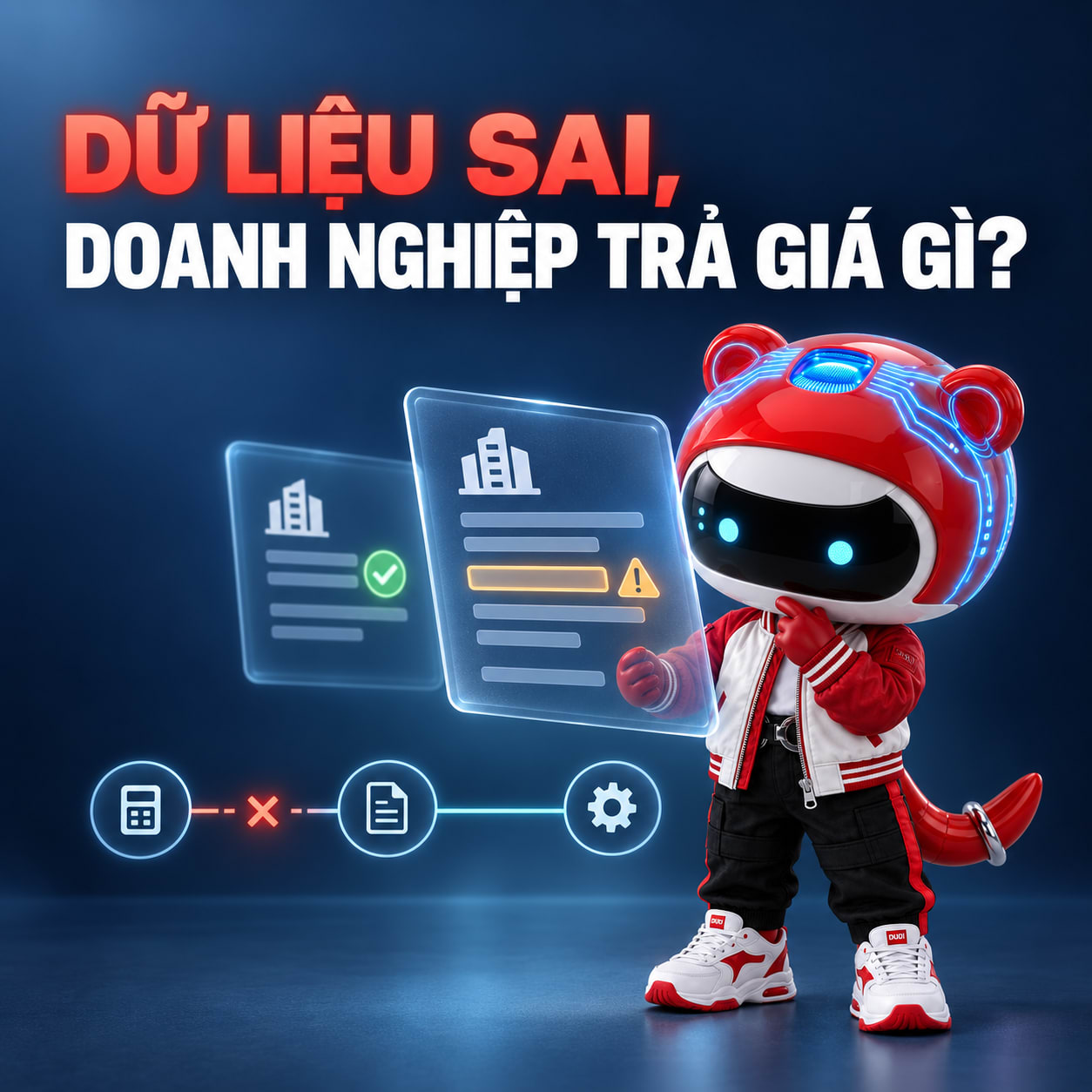
Incorrect data can cause businesses to cease transactions.
Even a single mismatch in legal status can block a business's invoices, transactions, and operating plans. The issue then shifts from entering incorrect data into a single field to the entire system relying on unreliable information.
The tax identification number cleanup campaign, launched in July 2026, has reviewed nearly 95,000 tax identification numbers and supported the resumption of operations for over 3,000 businesses. These figures demonstrate how data quality can directly impact a business's legal status and operational capabilities. Source: Vietnam Financial Times
DUDI Software's Perspective
From a system development perspective, the tax identification number is not just information to fill out on invoices. It is part of the original data, used to identify businesses in accounting systems, banks, contracts, payment gateways, and many other electronic transactions.
Incorrect information can be copied to numerous software programs. Only when a transaction is rejected do businesses discover that the error has existed in their systems for years.
The real concern isn't a review campaign. The bigger issue is how businesses are managing their legal data.
Legal data must have an official source.
A business may be storing its legal name, tax identification number, and address in multiple places: accounting software, ERP, CRM, website, invoicing system, contract files, and departmental spreadsheets.
If each location is updated separately, there's no guarantee the versions will always be the same. The accountant may have updated the address, while the website and contract forms still use the old information. The CRM records the trade name, but the invoicing software requires the correct legal entity name.
This is why businesses need to identify which system holds the original data. Other systems should only receive data from this source, rather than allowing each department to re-enter it independently.
When information changes, businesses only need to update it once. The system must record who made the change, what content was changed, when it was changed, and how far the data has been synchronized.
ERP is not just for managing accounting.
In many businesses, ERP is seen as the place to manage orders, inventory, and finances. But ERP must also maintain accurate relationships between legal entities, customers, suppliers, invoices, and financial obligations.
If the tax identification number or legal status is incorrect, a transaction may still be created by an employee on the system but cannot be completed at the invoicing or reconciliation step.
Therefore, ERP systems need mechanisms to check data before the process goes too far. Legal information should be verified when creating a partnership, before signing a contract, and before issuing documents. Detecting errors early in the process is always less costly than dealing with them after goods have been delivered or revenue has been recorded.
Websites and CRMs also use legal data.
Websites are often where customers or partners initiate a transaction. If the form allows for free data entry, the same business can be created multiple times under different names.
When this data is transferred to the CRM, sales staff may see multiple records but not know they belong to the same entity. Transaction history becomes fragmented, contracts are not linked to the correct customers, and sales reports become inaccurate.
The website or partner portal should support format checking, duplicate record identification, and the transfer of structured data into the CRM. The CRM should then link commercial customers to the invoicing entity, rather than treating contact names and business names as a single data field.
AI is only useful when the source data is reliable.
AI can assist in detecting duplicate records, alerting to unusual information, or finding transactions using expired data. However, AI cannot independently determine what constitutes legally accurate information if businesses do not identify the official data source.
If AI is trained or connected to multiple conflicting systems, the result will only be a prediction based on inconsistent data. Businesses will still need a verification process and a person responsible for approval.
The appropriate role of AI is early detection and suggested solutions. The right to legally validate data must still remain within a controlled process.
Where should a business begin?
- Identify a primary data source for the legal entity's name, tax identification number, address, and operating status.
- Check for synchronization between the website, CRM, ERP, accounting, invoicing, and contracts.
- Set up alerts, change history, and assign responsibility for verifying critical data.
Data is not a secondary component of technology. It is the foundation upon which invoices, contracts, customers, and operational processes are accurately connected. For sustainable growth, businesses need to invest in a sufficiently unified system to ensure that data is always accurate, traceable, and controlled throughout its lifecycle.