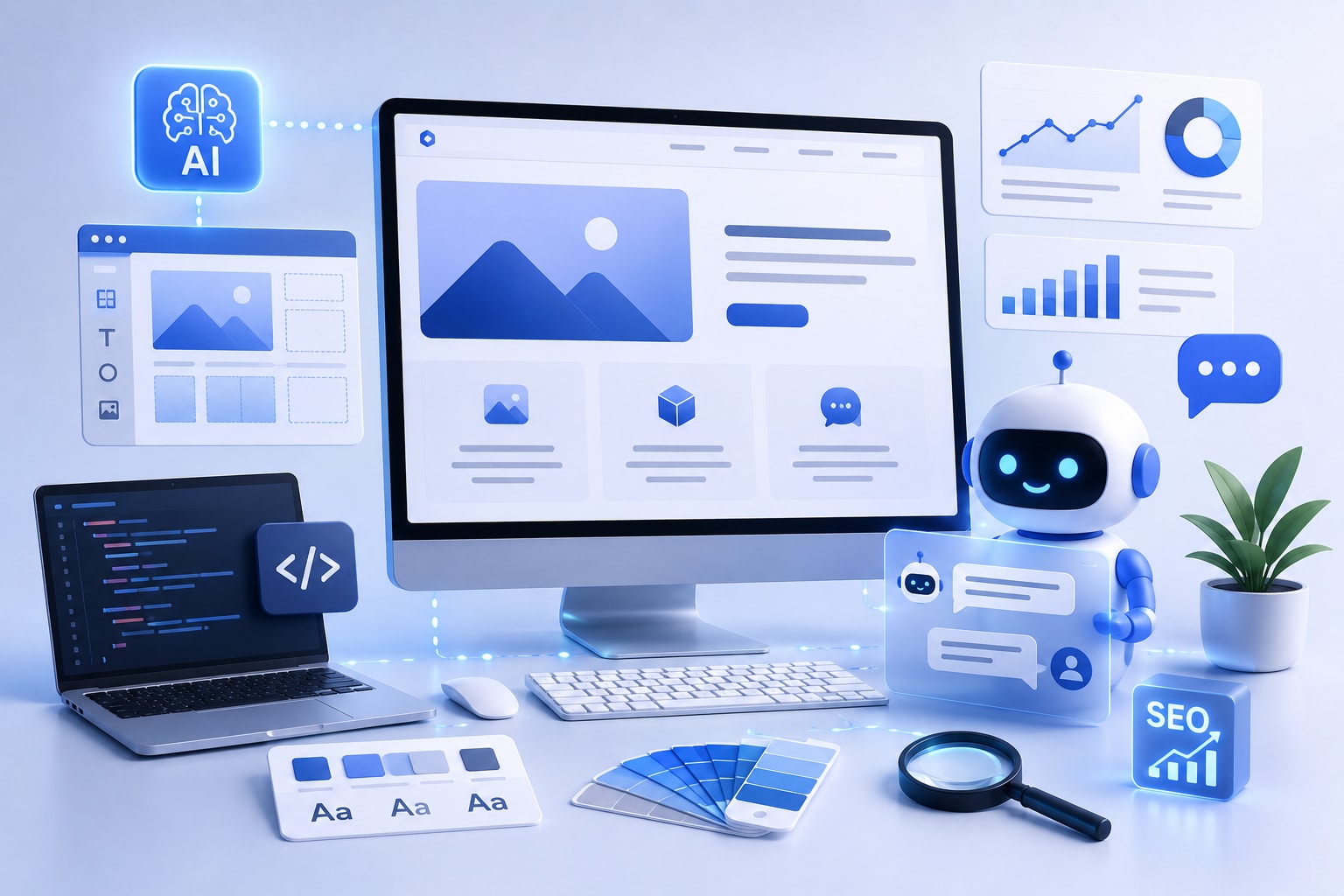
How are AI trends changing the website design industry?
AI is changing the website design industry
In recent years, artificial intelligence (AI) has become one of the fastest growing technologies. Not only applied in manufacturing, education or healthcare, AI is also creating many changes in the field of website design and development.
If in the past building a website required a lot of time to come up with ideas, design the interface and develop functions, today AI can support the automation of many tasks, making the deployment process faster and more effective.
However, AI does not completely replace humans but acts as a support tool, helping design and programming teams focus more on strategy, user experience and product value.
1. Support faster and more effective interface design
Currently, many website design platforms have integrated AI to support creating layouts, choosing colors, typography and suggesting how to arrange content based on the business field of the enterprise.
AI can analyze thousands of interface samples and provide appropriate suggestions, helping to shorten initial design time. This is especially useful for small businesses or projects that need to be implemented in a short time.
However, AI-generated interfaces still need to be edited by the design team to ensure aesthetics, brand recognition and user experience.
2. Personalize user experience
One of the biggest advantages of AI is its ability to analyze user data.
Through access behavior, search history or interactions on the website, AI can recommend content, products or services suitable for each customer.
For example:
- Show related products based on viewing history.
- Recommend articles suitable to topics the user is interested in.
- Personalize content by geographic location or language.
- Suggested promotional programs specific to each customer group.
Personalization helps increase user experience, prolong website stay and improve conversion rates.
3. Support for content creation
AI is becoming an effective support tool for Marketing and Content teams.
AI tools can:
- Suggest article topics.
- Support writing drafts.
- Suggest SEO standard titles.
- Create product descriptions.
- Check for spelling and grammar errors.
- Suggest related keywords.
However, AI should not be used to create entire content without verification. Quality content still needs to be edited by humans to ensure accuracy, relevance to target customers and true reflection of brand values.
4. AI chatbots improve customer care quality
More and more businesses are integrating AI chatbots on their websites to quickly support customers.
Unlike traditional chatbots that only answer according to available scripts, AI chatbots are capable of understanding natural language and giving more flexible answers.
AI Chatbot can support:
- Answer frequently asked questions.
- Introduce products or services.
- Instruct customers to place orders.
- Collect potential customer information.
- Customer support outside working hours.
Thanks to that, businesses can improve customer experience and reduce the load on the customer care team.
5. AI supports SEO optimization
AI does not directly help websites achieve high rankings on Google, but can support the SEO optimization process more effectively.
Some popular applications include:
- Keyword analysis.
- Suggested article structure.
- Check the readability of the content.
- Suggest title tags and descriptions.
- Analyze competitors.
- Monitor search trends.
However, Google still prioritizes content that brings real value to users. Therefore, AI should only be considered a support tool, while SEO strategy still needs to focus on content quality and user experience.
6. Data analysis and decision support
Modern websites can collect a lot of data about visitor behavior.
AI helps businesses:
- Analyze traffic.
- Identify pages with high bounce rates.
- Discover the most popular content.
- Predict customer behavioral trends.
- Give suggestions to improve website efficiency.
These data help businesses make faster decisions and optimize business operations.
Will AI replace designers and programmers?
This is a question that many people are interested in.
In fact, AI can help automate many repetitive tasks, but cannot completely replace the website design and development team.
A professional website not only needs a beautiful interface but also must meet business goals, user experience, security, scalability and optimal performance. These factors still require human thinking, experience and problem-solving ability.
It can be said that AI will becomean assistantthat helps designers and programmers work more effectively, instead of replacing them.
What should businesses prepare for in the AI era?
To effectively utilize AI in the process of building and developing websites, businesses should:
- Proactively update new technology trends.
Combine AI with the experience of a professional team.
- Invest in quality and useful content.
- Optimize user experience on all devices.
- Track data to continuously improve the website.
- Build a sustainable SEO strategy instead of relying entirely on AI.
Conclusion
AI is opening up many new opportunities for the website design industry, from supporting interface construction, content optimization, data analysis to improving customer experience. However, AI is only truly effective when combined with creative thinking, professional experience and a clear development strategy.
In the future, businesses that know how to properly apply AI will have an advantage in building modern websites, improving business efficiency and quickly adapting to changes in the digital environment.