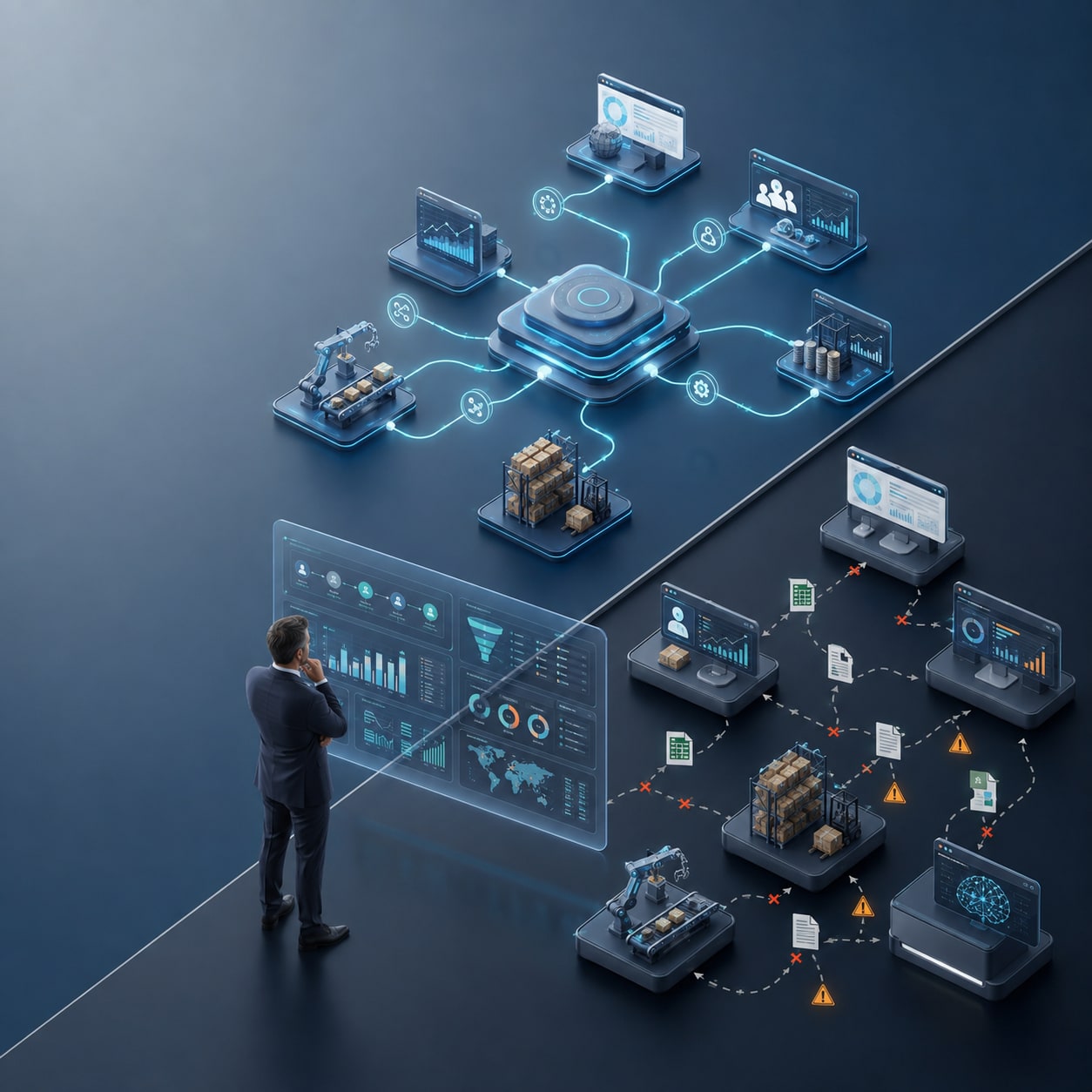
Discrete automation does not create a digital business
Businesses can invest in robots, software and AI but productivity still does not improve. The problem is often not the technology, but the fact that each technology is operating like an island.
“Technology oasis” is a situation where a business owns many solutions but data, processes and people are not connected in a unified system. The sales department uses CRM, accounting has financial software, inventory management is on another platform, while production operates with its own machinery or software. When the board of directors needs a comprehensive report, the data still has to be compiled using Excel and processed manually.
Looking at each department separately, the enterprise has applied technology. Looking across the entire operational chain, businesses are still relying on people to connect systems together.
The important thing is not how much software a business has
If viewed from the perspective of system construction, the number of software or automated devices is not an accurate measure of the level of digital transformation. The question to ask is whether the data goes all the way from customers, sales, production, logistics to accounting.
A robot can shorten the time to complete a step. But if raw materials are still allocated manually, production results have to be re-entered into Excel, and the warehouse department does not receive real-time data, the speed of the entire enterprise remains almost unchanged.
Similarly, CRM can help sales staff manage sales opportunities. But if the order after closing still has to be emailed to accounting and warehouse, the new CRM only helps one department work more conveniently. It hasn't changed the way businesses operate.
This is the difference between automating a task and transforming a process.
“Technological oasis” formed from reasonable decisions
Most businesses do not proactively create a discrete system. This condition often forms gradually over the course of development.
When the sales department has difficulty managing customers, the business buys a CRM. When warehouses often have inventory discrepancies, businesses deploy warehouse management software. When accountants need to control debt, another system is put into use. Every decision addresses a real need.
The problem appears when a business does not have an overall architecture that defines the role of each system. No one clearly answers which data is considered original data, which systems are authorized to update and how data must be exchanged between departments.
As a result, the same customer can exist under many different names. The inventory quantity displayed on the website does not match the data in the warehouse. The order has been confirmed in CRM but production is still waiting for an Excel sheet. The sales department's revenue report is different from accounting data because the two sides use different times and recording methods.
The software still functions properly. The deviation lies in the space between them.
The website must be the starting point of the data flow
For many businesses, the website is the first place to record customer needs and behavior. However, if the form on the website only sends an email to sales staff, the business has not truly digitized the customer reception process.
Employees still have to read emails, re-enter information into CRM, identify who is in charge, and categorize needs. This process is both time-consuming and creates the risk of omissions, incorrect entries, or failure to record customer sources.
A properly integrated website must bring data directly into the management system. The customer needs to be identified, the source of access must be recorded, and the request must be routed through the correct process. When customers return, businesses need to know what products they were interested in, who they talked to and what stage they are in the purchasing journey.
The website was no longer an independent introduction channel. It becomes part of the business system.
CRMs must manage journeys, not just store information
CRMs often fail when used as an extended directory. The real value of CRM lies in the ability to manage the entire customer journey, from the moment a need arises, receiving advice, quoting, signing a contract to using the service and needing support.
To perform that role, CRM must connect with the website, quote system, orders, accounting and customer care. Otherwise, employees only see part of the information, and management can't see where customers are stopping or what caused a lost sales opportunity.
CRM should not be the place where employees enter data for month-end reports. It must be a tool to coordinate daily business activities.
ERP is a standardized operating platform
ERP is not simply an accounting software with more functions. The most important role of ERP is to standardize data, responsibilities, and approval flows across departments.
When an order is confirmed, the system needs to check inventory, determine purchasing or production needs, update delivery plans, and record financial obligations. Each step must inherit data from the previous step instead of recreating a new set of data.
However, implementing ERP does not mean bringing all current practices into the software. If the process is not clear, responsibilities are not assigned, and data is not of a common standard, ERP will only make an inconsistent process run faster.
Enterprises must standardize processes before automating processes.
AI cannot fix a weak data base
AI can forecast demand, classify customers, detect anomalies or suggest production plans. But the quality of the results depends on the data the AI is allowed to use.
If customer information is duplicated, inventory updates are slow, and transaction history is spread across multiple systems, AI cannot create a unified view. It just processes data that is inherently inconsistent faster.
The bigger risk is that a business could automate a wrong decision on a large scale. One wrong forecast used manually can affect several decisions. An incorrect forecast that is directly connected to the purchasing or manufacturing process can create much greater consequences.
Therefore, AI should be seen as an advanced layer of operational systems. The foundation remains clean data, clear processes, and controlled access.
Businesses do not need additional software, but need a common architecture
Businesses do not necessarily need to use a single platform for all activities. CRM, ERP, websites, applications and specialized systems can come from many different vendors. An important condition is that each system must have a clear role and be able to exchange data according to a common architecture.
Websites and applications manage interaction points. CRM manages the customer journey. ERP manages resources and operational transactions. Warehouse, production or logistics systems handle specialized operations. AI supports analysis and automation on managed data.
When these components connect properly, a change at the beginning can be reflected throughout the entire process. Businesses reduce data re-entry, limit errors and get reliable enough data to make decisions.
Three lessons for businesses
- Redraw the entire data flow and process before deciding to buy additional software.
- Clearly define the system for storing master data for customers, products, inventory, and orders.
- Evaluate technology projects by the efficiency of the entire process, not just the speed of one part.
A sustainable business does not need to own the most technology. Businesses need a unified enough platform for data, people and processes to operate together towards the same goal. Then, new technology truly becomes a development capacity instead of a set of discrete investments.