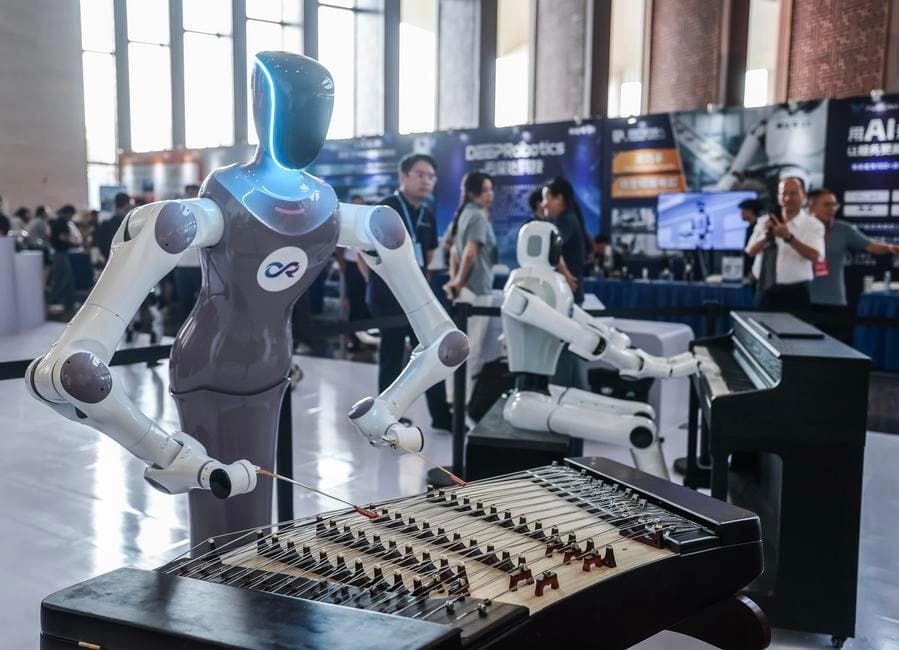
The Era of "Incarnate AI": When Artificial Intelligence Steps Off the Screen and into Real Life
For many years, the world has become familiar with an invisible artificial intelligence (AI). We communicate with AI through chats, image recognition software or virtual assistant platforms on mobile phones. However, the boundary between the virtual world and reality is officially being broken with the rise of "Embodied AI" - a turning point marking the moment artificial intelligence officially owns a physical body.
In essence, embodied AI is the ultimate convergence between multimodal Vision-Language Models and advanced robotics techniques. Instead of just processing text or static data on a server, AI systems now act as "brains" implanted into humanoid robots or industrial mechanical arms. Thanks to a complex sensor system and camera system that collects data in real time, AI is capable of observing multi-dimensional space, understanding physical context and automatically making complex movement decisions.
The core difference of this new generation of AI robots lies in the ability to reason and learn on their own. In the past, industrial robots only operated stereotypically according to each pre-programmed command line (hard-code). Currently, thanks to platform models specific to physical space, robots can observe humans performing a task - such as arranging components or moving objects - then automatically imitate and self-adjust the impact force through Reinforcement Learning. They have the ability to handle unexpected situations and continuously adapt to the surrounding environment.
The application potential of this trend is attracting billions of dollars in investment from global technology corporations. In the short term, robots equipped with embodied AI are starting to penetrate manufacturing plants and logistics warehouses to perform dangerous and heavy work on behalf of humans. In the long-term roadmap, this technology promises to bring machine entities into the medical environment, elderly care and direct service in households.
Although still facing many challenges in terms of hardware cost barriers, battery life and ethical safety standards, the trend of physicalizing artificial intelligence is an irreversible flow. The concept of automation is being comprehensively upgraded, opening a new era where machines not only know how to "think" intelligently but also know how to "act" skillfully as an independent entity in the human world.