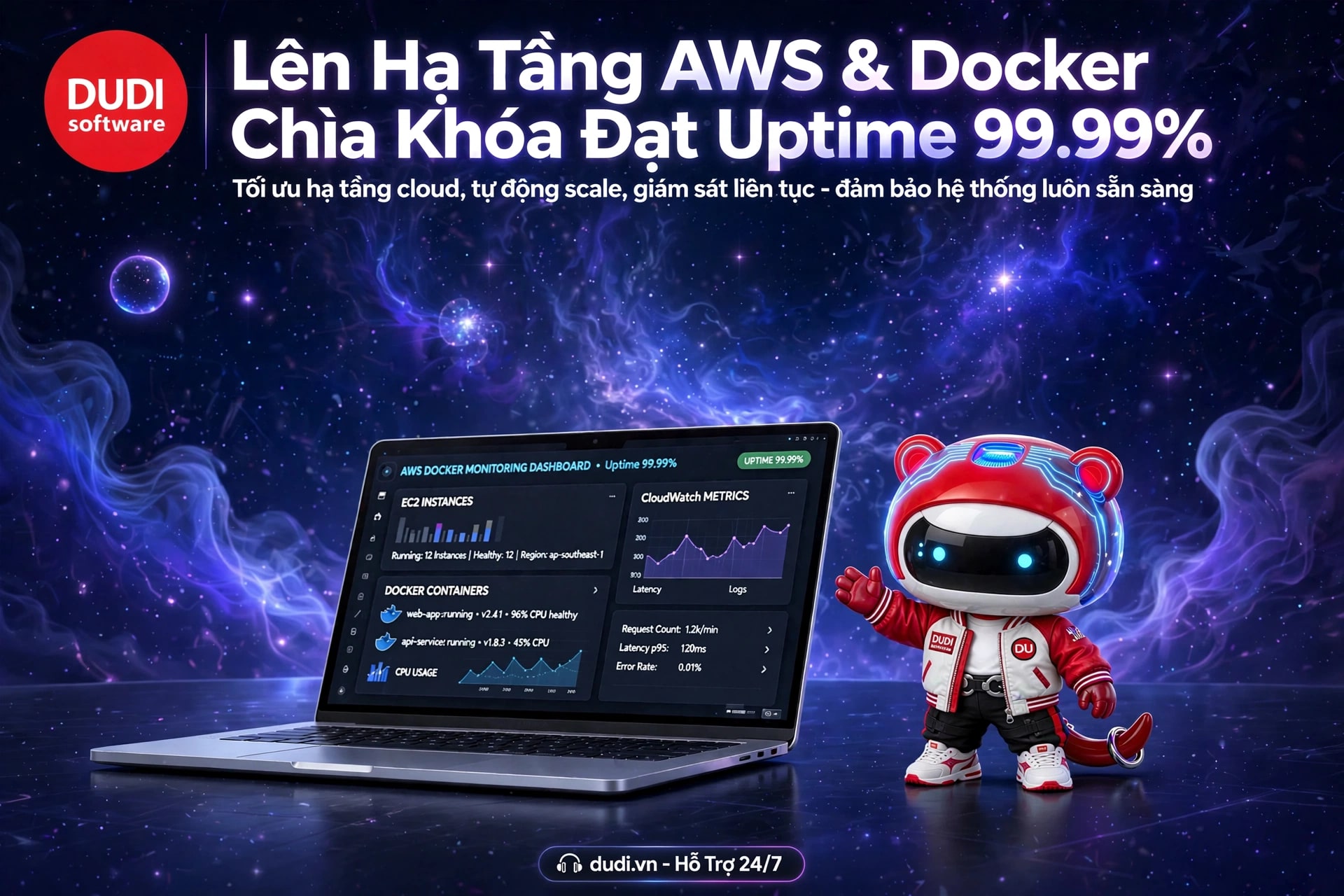
Bringing Website to AWS & Docker Infrastructure: The Key to Achieving 99.99% Uptime
In the fiercely competitive digital business environment, a single moment of website downtime can cost businesses tens of millions of dong and result in the loss of countless potential customers. Traditional hosting systems like shared hosting or cheap VPS frequently experience overload, causing bandwidth congestion and shutdowns when traffic from marketing campaigns surges. To thoroughly address this issue, migrating infrastructure to the AWS (Amazon Web Services) cloud platform combined with Docker virtualization technology is becoming a mandatory technological standard.
The combination of AWS and Docker provides the ability to deconstruct and package source code with complete independence. Each core feature of the website runs in a separate "container," without interfering with each other. This allows for safe functional upgrades or bug fixes without disrupting the entire system.
Specifically, the AWS cloud system offers an auto-scaling mechanism. When the system detects a large influx of simultaneous visitors, the server automatically duplicates containers to share the load. As soon as traffic decreases, the system automatically shrinks them to optimize operating costs for the business.
In terms of search engine optimization (SEO), Google's algorithm always prioritizes websites with low server response times (TTFB) and uptime of 99.99%. AWS infrastructure ensures your website is always responsive, loading pages in under 1.2 seconds, thereby directly improving your ranking on the first page of Google.
At DUDI Software, we design and package 100% of our clients' custom website projects on the Docker platform and deploy them to AWS infrastructure. Businesses not only receive a modern interface but also a robust technical core.