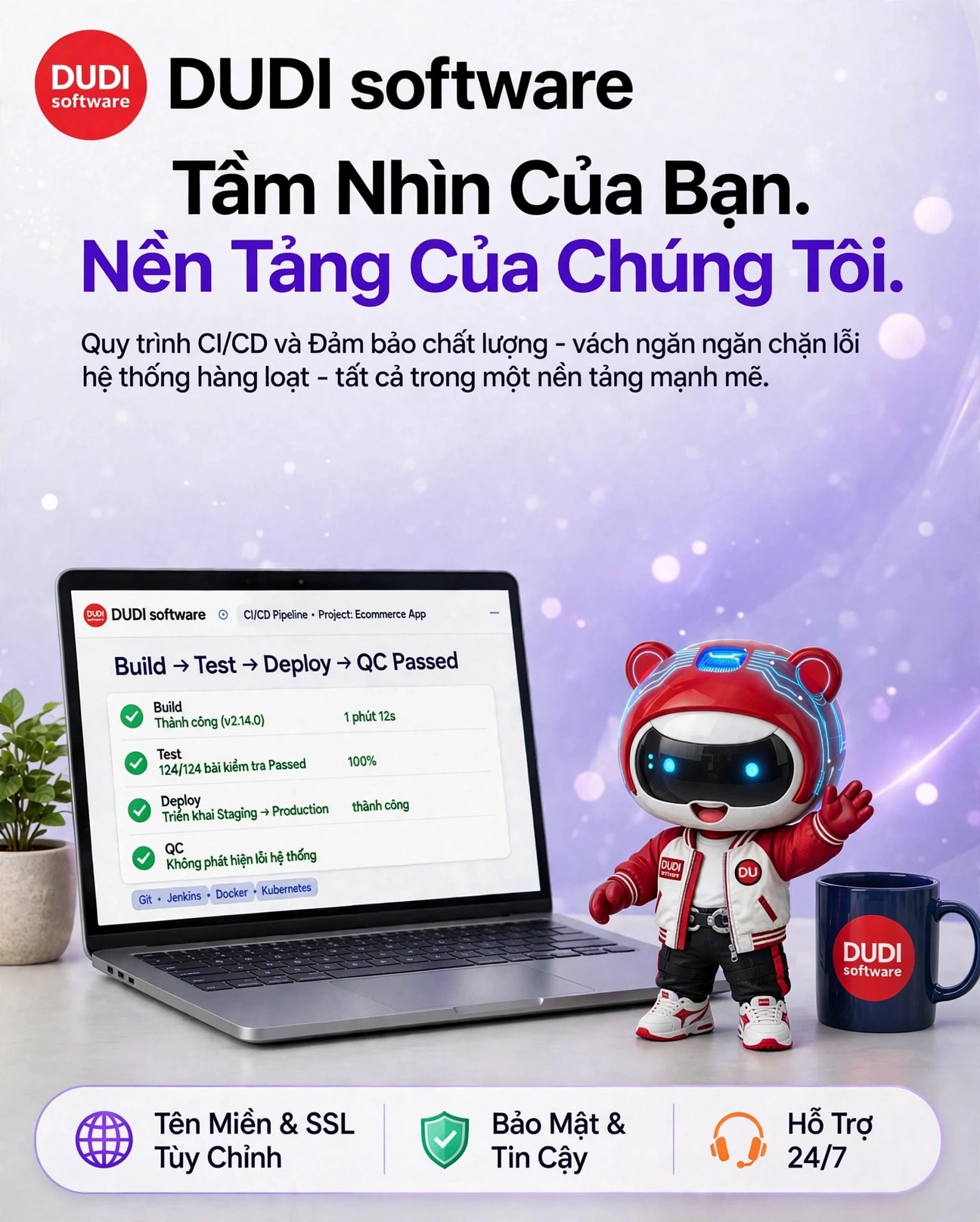
CI/CD Process and Quality Assurance (QC): Bulkhead Prevents Massive System Errors
In the context of the digital economy, a website is not just an advertising sign but the entire lifeblood of a business's operations. Every day, websites process thousands of payment transactions, record tens of thousands of visits, and store a large amount of sensitive customer data. However, many businesses today, when hiring web design companies, only focus on the handover date of the interface, overlooking a crucial technical standard: automated quality control (QC) and continuous improvement/conversion (CI/CD) processes.
The Disaster of Manual Source Code Updates: In traditional or low-cost web development processes, whenever a business wants to add a new feature (e.g., adding a VietQR payment gateway) or fix a minor interface bug, programmers directly modify the source code and upload it straight to the origin server. This carries extremely high risks. Even a misplaced comma in the configuration file can cause the entire website to crash (downtime), the shopping cart function to malfunction, or, more seriously, create critical security vulnerabilities.
Without a rigorous source code control process, website development is like adding floors to a foundation without a blueprint. Each update is a moment of anxious waiting to see if the system has any errors.
Quality Control (QC) and Automated Testing Standards: To completely eliminate technical errors arising during operation, an enterprise-level web system must integrate a comprehensive Software Quality Control (QC) process right from the coding stage.
At DUDI Software, we don't rely on visual inspection or manual, subjective clicking to check for errors. Our engineering team sets up automated test scenarios using leading tools like Selenium (for testing user interface behavior) and JUnit (for testing the logic of independent code blocks on the backend). Any code change, however small, must pass hundreds of these rigorous test cases. If any function malfunctions, the system immediately blocks the update.
CI/CD: The Key to Zero Downtime Feature Updates. CI/CD (Continuous Integration/Continuous Deployment) is a fully automated process for integrating and deploying source code. When working with DUDI Software, this process is tightly integrated through automated workflows (such as GitHub Actions).
What does this mean for your business? It means that when your website needs an update to a new promotional interface or a data structure upgrade, the process of uploading the source code to the server will be done automatically by the system. The transition between the old and new versions happens in a fraction of a second. Your customers can continue shopping normally without encountering any "Website under maintenance" messages. Importantly, if the new update has problems, the CI/CD process allows the system to immediately roll back to the previous stable version to maintain business operations.
Investing in technical infrastructure is investing in the future. A website with a professional development process, combined with a Docker packaging environment and cloud hosting, will completely eliminate the problem of "technical debt." Page load speeds will not only be optimized to under 1.2 seconds in the first month, but will also remain stable for many years of operation afterward.
When receiving 100% full source code from DUDI Software, businesses not only get a clean set of source code but also inherit the entire testing architecture and automated deployment process. This ensures that any internal IT team taking over the project in the future can confidently develop new features without worrying about breaking the original platform.