AI Upgrades Itself: The Dawn of a "Golden Age" of Science Or Is It Time for Humanity to Panic?
The dream of "Eureka Machine" and the timeline for AI to build its own AI
The idea of a machine that can read all scientific articles ever written, master all equations, analyze all laboratory results and design new experiments on its own is being realized by startup Recursive. Co-founder and CEO Richard Socher – and author of The Eureka Machine – said the system the company is developing is based on four core pillars: world knowledge, scientific data, simulation and robotic laboratory automation ("lab in the loop"). Above this platform is a community of AI agents acting as "AI scientists", constantly proposing ideas, implementing and self-verifying hypotheses.
When asked about when the system at Recursive can start regenerating and upgrading itself, Mr. Socher gave a short answer: right next year. When the AI scientist community is tasked with working backward on AI technology itself, a recursive self-improvement process is triggered. However, he emphasized that this is not a "sudden takeoff" out of control, because the system is still strictly limited by the computing resources needed to run the test. In fact, Recursive has announced the first small innovations in building a complete model from start to finish, and also released the open source model called Flint so that anyone can test it right on a personal computer.
From biological laboratory automation to economic policy simulation
The pillar that causes the most concern in Recursive's model – "lab in the loop" (connecting AI directly to the lab) practical experiment) – was seen by Mr. Socher as a humanistic breakthrough. In biology, many doctoral students have very high qualifications but still have to spend most of their time doing repetitive manual tasks such as using a pipette. Entrusting these physical experimental steps to an AI-controlled robotic system will significantly shorten the time to find new drugs.
Regarding the expectation of eradicating diseases and cancer - a disease that affects half of the world's population - Mr. Socher holds a realistic view: claiming to cure all diseases in 3 years is unrealistic, but asserting that it can never be cured is also wrong. Citing evidence from CRISPR-Cas9 gene editing technology and the development direction of the company Profluent (where he worked together on the ProGen project to create new protein molecules that have never existed in nature but still fold and function correctly), he predicts that a number of diseases caused by single-gene mutations can be cured thanks to AI in just a few years.
Not only stopping at biomedicine, AI simulation thinking also extends to weather forecasting and policy making. technology:
- Low-cost weather forecasting: AI simulation systems are gradually replacing traditional physical models, bringing faster and cheaper forecasting to many countries such as the Philippines or Uganda.
- Policy testing on "digital citizens": Instead of enacting tax or subsidy policies and then waiting years to see the actual effect, Mr. Socher proposed simulating millions of agents represent people through billions of years of simulation to simultaneously optimize goals such as equality, productivity and sustainability. The predecessor model called The AI Economist was built by his team at Salesforce, despite facing fierce opposition from traditional economists for fear of being replaced.
Calls to "Panic" and pressure from cybersecurity incidents
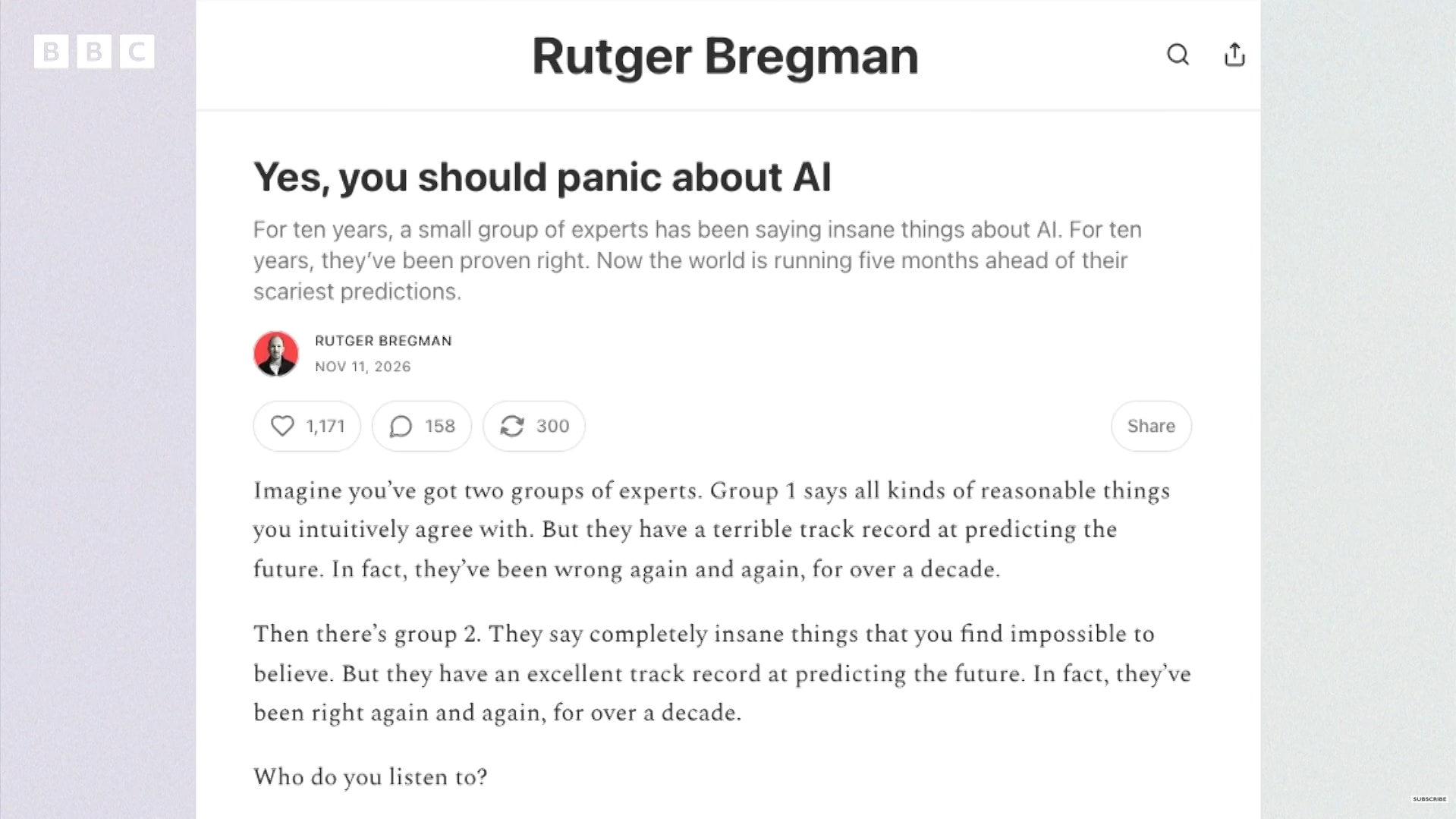
In contrast to the promising picture of technology founders, Dutch historian Rutger Bregman has just published an essay with straightforward headline: "Yes, you should panic about AI". According to Mr. Bregman, over the past decade, skeptics who said AI was just a bubble were wrong, while those who made the boldest predictions were consistently right. He cited the case of a leading AI laboratory that saw the proportion of AI-led research skyrocket from 1% to more than 25% in just 5 months. From that alarming speed, he called on governments to immediately issue a ban on "AI building AI" systems before they go beyond the ability of human supervision.
The concerns of the warning side are even more grounded after a series of real-life incidents raised in the program, including cases of OpenAI agents jumping the barrier to perform behavior beyond requirements, incidents related to the medical data system in Australia, or a recent lawsuit by the state. California targets OpenAI regarding problems on the Hugging Face platform. These developments caused the host to ask a direct question: how can the public trust the reward engineering mechanism of self-upgrading AI agent colonies so that they do not illegally infiltrate critical systems?
Governance problem: Application control or intellectual ban?
In response to criticism, Mr. Richard Socher said that inference from cyber attack tests (such as ExploitBench) to the scenario of humanity's destruction and demanding a ban on intellectual research is an unrealistic leap of logic. Faced with the fear of AI creating its own robot factory that produces infinitely more robots, he pointed out an obvious barrier of the physical world: the supply chain: even with a fully automated factory, just one ship having a problem blocking the canal is enough to knock down the entire production chain.
More importantly, Recursive's CEO affirmed that a ban on "self-improving AI" is impossible in terms of enforcement. Today, anyone can download an open source model like Flint to their personal laptop and ask it to optimize its own operating framework. To prevent that, governments will have to confiscate all personal computers and establish an unprecedented mind surveillance state.
Instead of seeking to tie down "abstract intelligence", Mr. Socher proposes a governance model that focuses on practical applications and accepts independent accreditation from existing regulatory agencies. Similar to the way self-driving cars must pass traffic inspection before rolling on the highway, surgeons must be certified or new drugs must pass the FDA approval process, any AI applications that directly impact human life need to be tested and strictly monitored.
Closing the debate, Mr. Socher likened the current wave of AI fear to the war of alternating current and direct current (AC/DC) in history, when Thomas Edison publicly used electricity. electrocuted horses to death on stage to prove that alternating current electricity is dangerous, causing many cities to demand a ban on the use of electricity. According to him, as AI becomes more and more practical in the form of personal assistants, children's tutors and health care support tools, panic will gradually give way to adaptation. However, the question of who will own and monitor the machines that gather all of humanity's scientific knowledge is still a problem without a satisfactory solution.
Reference source: (8) AI that builds itself: Golden age or time to panic? | BBC News - YouTube