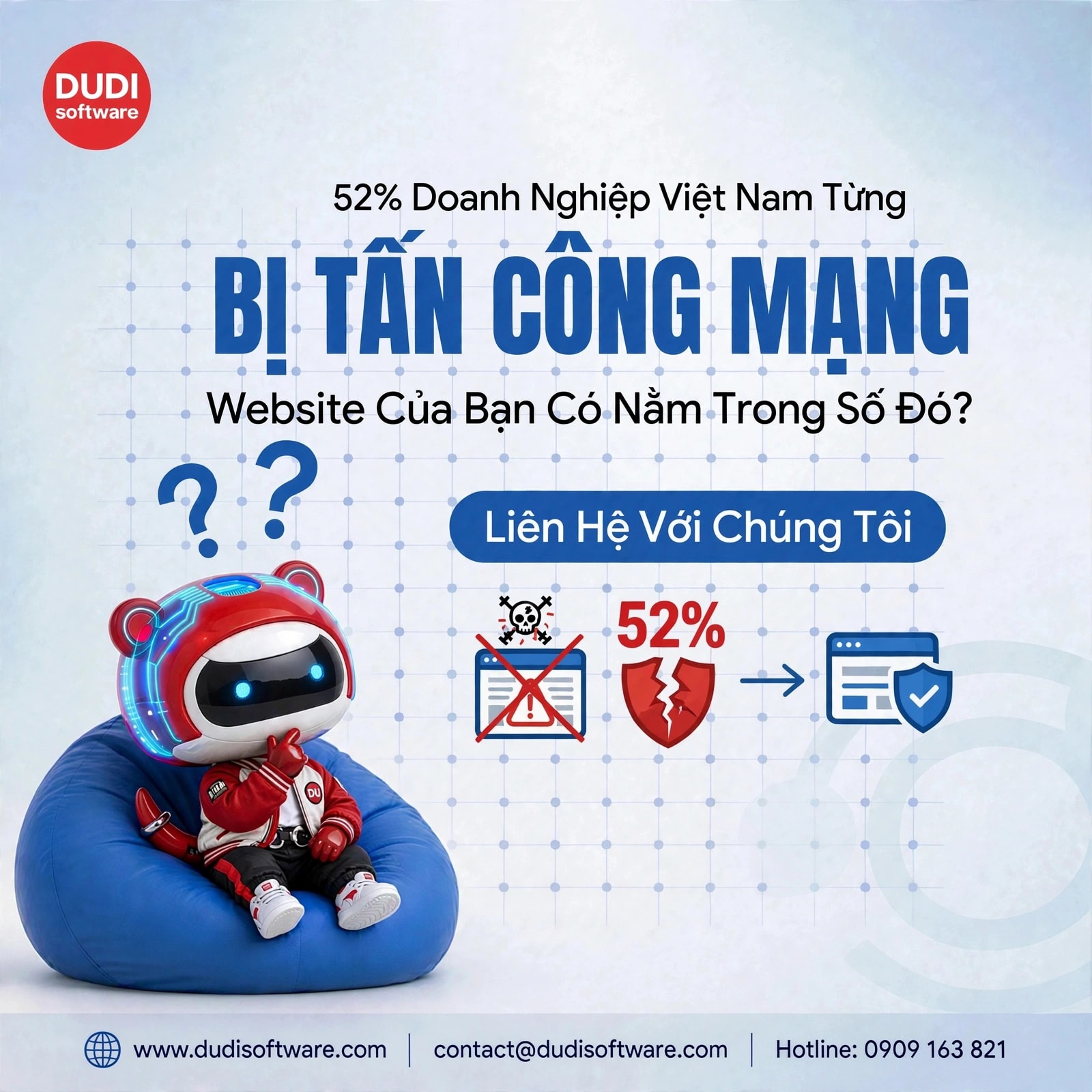
52% of Vietnamese Businesses Have Been Under Cyber Attacks — Is Your Website Among Them?
According to a report by the National Cybersecurity Association, approximately 52% of businesses in Vietnam were targeted by cyberattacks in 2025 — and remarkably, even organizations with robust security systems were not immune.
Many small business owners still hold the mindset that "my company is small, nobody will bother to attack it." But the reality is showing the opposite: recent surveys indicate that small and medium-sized enterprises (SMEs) in Southeast Asia, including Vietnam, are becoming increasingly common targets of ransomware — precisely because this group typically has lower security budgets and is more vulnerable to exploitation than large corporations.
In this context, a website designed without prioritizing security from the outset—focusing only on a beautiful interface—inadvertently becomes one of the most vulnerable gateways to exploitation. This is something many businesses overlook when choosing a web design company: the question isn't just "is the website beautiful?", but also "is the website built securely?".
My point of view is quite clear: security is not a feature to be added later when there's a generous budget, but should be considered right from the website design and implementation phase — just like the foundation of a house, you can't build it first and then reinforce it later.
Three things businesses need to check and ensure immediately regarding their website:
First, the SSL/HTTPS certificate must be properly installed and maintained — this is the minimum requirement to protect data transmitted between customers and the website, and it is also a factor Google considers when ranking in search results.
Secondly, platforms, plugins, and website source code need to be updated and patched regularly — most attacks exploit vulnerabilities in outdated, unpatched software versions, a very common problem with websites that are rarely maintained after handover.
Third, there should be a mechanism for regular and independent data backups—so that if something unfortunate happens (attack, data loss), the business can quickly restore it instead of losing all accumulated content, orders, or customer data.
A fairly common scenario: many businesses, after receiving their website, hardly update or maintain it for years, until they discover that the website has been infected with malware, data has been lost, or its administrator privileges have been compromised — at which point the cost of remediation and reputational damage is often far greater than the initial investment in security.
If your business website has never been checked for the basic security elements mentioned above, now is the time to do so — not out of excessive fear, but because it's an essential responsibility when operating a digital channel that represents your business and stores customer data.
When designing websites for businesses, DUDI Software always places security as an integral part of the process — from SSL installation and security configuration to providing guidance on regular updates and backups after handover.