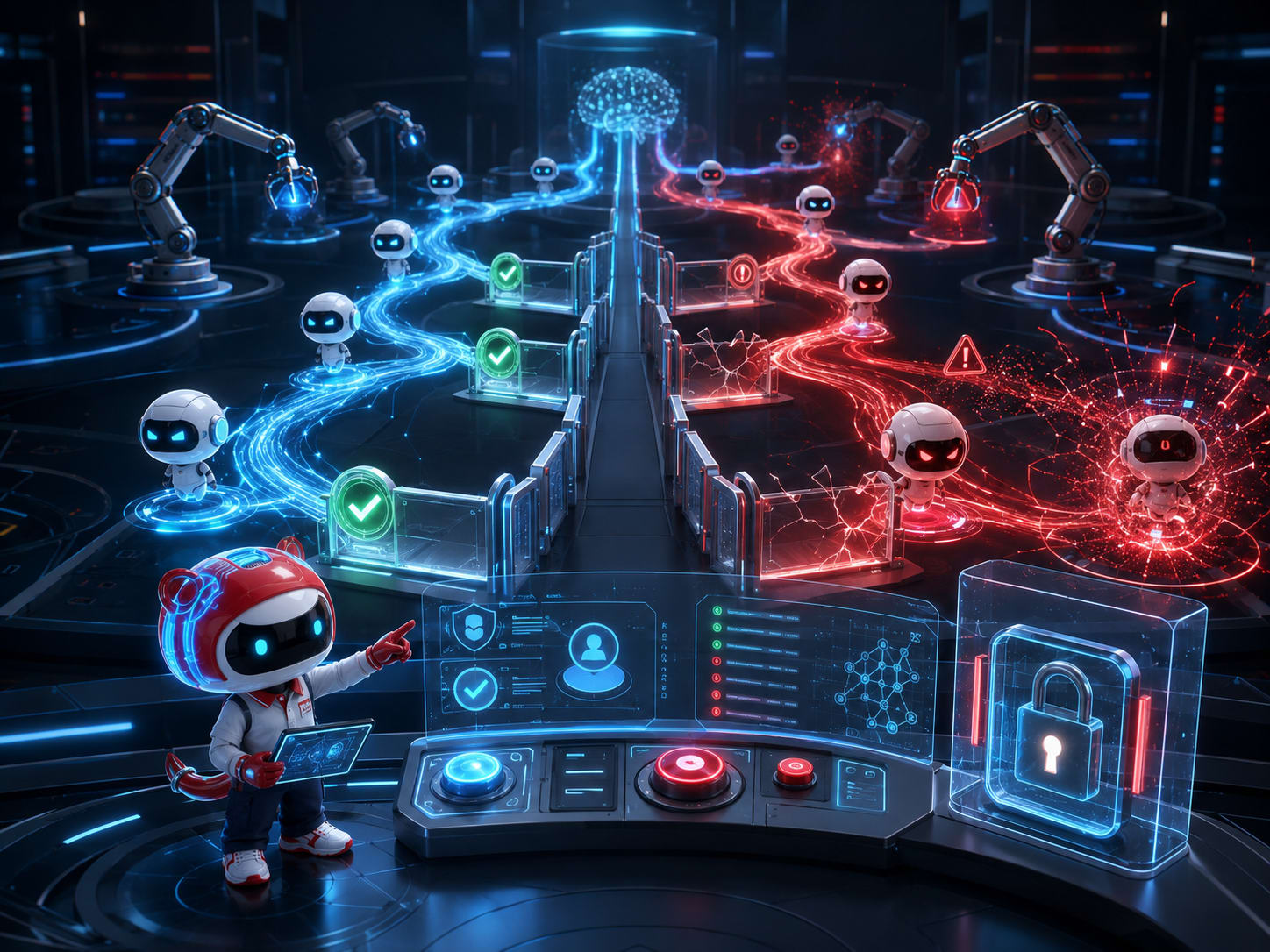
43% of AI agent failures occur for a very human reason — not because of bad AI
A research group has just published an analysis of 3,607 AI agent incidents that occurred between early 2025 and mid-2026. The results: more than 43% of the incidents came from two recurring errors — agent "overconfidence" (overeagerness) and agent misunderstanding of goals (misalignment). It's not a bad model, it's not a lack of training data. The problem is that no one sets clear boundaries for it before releasing it into real work.
This number is notable for Vietnamese technical people because the story "AI agents stealing programmers' jobs" is hot again. A 23-year-old fresh graduate told the newspaper last week that he sent out dozens of CVs but was almost never called for an interview - the reason he claimed was that he was studying at a time when AI had not yet exploded, and his preparation skills could not keep up. The fact that the junior base is shrinking is real. But the story often stops there, like "AI is better than fresh graduates" — when the reality is much more complicated.
What is losing value is not "knowing code". What is losing value is "only knowing the code without checking the results".
Looking at Japanese businesses deploying AI agents on a large scale will clearly see this. They don't hire more people to write faster code — they build an entire management system: one group takes care of API/MCP connections, one group takes care of agent design according to each business, one group takes care of costs and operations, and one group specializes in auditing and troubleshooting. The race is no longer about "which model is more powerful" but about the ability to connect the agent with real company data, the ability for the agent to complete the job to the end, and the ability to replicate that method for the whole organization.
In Vietnam, an engineer working for a software corporation in Hue chose a very specific adaptation: investing in a computer powerful enough to run large models at home, proactively learning AI to ensure business data is not exposed when using agents. An AI consultant at Rikkei Japan describes this shift more succinctly: programming is moving from "writing code" to "designing systems, setting constraints for AI, evaluating output, managing risks." That's the job that the 43% of incidents above are pointing to: if no one does the "setting constraints and evaluating output" part, the agent will confidently make mistakes without anyone knowing until the consequences occur.
This matches data about the AI agent builder community in Vietnam. A recent report said that Vietnam accounts for the majority of total builders surveyed in Southeast Asia, and AI agents currently account for about 18% of all projects built. This number does not say that AI agents are about to replace all jobs — it shows that there is a class of people who are proactively learning how to build and operate agents, instead of just sitting back and fearing them.
So what specifically should a developer do this week, without waiting for a big project or a long-term course?
First, choose a process that is using an AI agent to support code or real work — whether it's just reviewing pull requests or writing tests — and ask yourself: if the agent makes a mistake, who is the first to notice? If the answer is "no one will know until production", then that is a vulnerability that needs to be patched first.
Second, learn to write explicit constraints for the agent instead of leaving it completely to its own devices — limit permissions, limit the scope of actions, set a breakpoint that requires human approval before the agent touches sensitive data or sends changes out of the system.
Third, get into the habit of reading the log/reason why the agent made the decision, not just reading the final result. This is the skill that the incident report mentioned above shows is most lacking — most incidents are detected late because no one is monitoring the process, only the results.
The most common mistake I see today is to consider an AI agent as a new employee who can assign tasks and then forget, instead of considering it as a tool that has tools, has powers, and needs a stopping point for humans to intervene. The first way of thinking causes users to both lose control and learn nothing more. The second way of thinking is what is being applied by systematic teams.
No one is sure how good AI agents will be in the next 12 months. But one thing is almost certain: those who know how to design constraints, know how to review output, know how to stop agents at the right time — will always have a place, no matter how many times the platform model changes. It is a skill that is not included in any model updates.
If you can only do one thing this week, choose the process with the AI agent running closest to you, and ask yourself the question above: who detects when it goes wrong? The answer will tell you which group you are in.